Exhibition in development · November 2027
EUFÓRIA — The Anatomy of Presence
A tribute to the spirit of Robert Capa · 20 works · Created March 2026 – September 2027

The concept
“Photography, for me, is not documentation but a state of being. A state of mind. Presence. Pure force.”
There is a duality that has run through my whole life. I am an applied photographer — and an artist. Commissions, deadlines, briefs on one side; inner visions, silences, questions on the other. For years those two worlds ran in parallel, sometimes against each other, sometimes feeding each other. Today I know I never had to choose. That tension made me who I am, and EUFÓRIA is where both finally point in the same direction. Not a closure. An arrival.
The idea came from my muse. She is the one who walked this road with me and believed in what I do even when I did not quite believe it myself. Her passion is dance. When she dances something breaks free — in her, and in the room. Energies move that can shake the saddest person awake and pull them back into life. I have lived through that state beside her more times than I can count. Only now do I understand that I am ready to create inside that vibration. Not to shape it. Not to filter it. To give it back, unveiled.
In EUFÓRIA I am photographing exceptional people of Hungarian origin, at home and around the world. Artists, creators, entrepreneurs, athletes. I am not looking for celebrities — I am looking for characters who already move the world around them, caught in the moment they step beyond themselves. When the momentum is no longer controlled, but free. There is always a conversation first: respect, trust, a shared language. Without those there is no work. But the moment itself can never be staged. Never choreographed. Never replayed. I want the spark that is born right there, and I want to pass it on one to one. If the vibration is not there, there is no picture.
This will not be a classical photography exhibition but a total work of art — image, music, technology and human stories in one space. Twenty works. I am making them between March 2026 and September 2027, and we open in November 2027. And here is the part I love most: the people in it are chosen by you, through the community's recommendations.
“This exhibition is also an homage. Robert Capa believed that if you are close enough to a person, the picture will be true. EUFÓRIA is the continuation of that faith, told in my own language.”Continuously updated gallery — Flickr
Work Nº 1
Péter Magyar — Heroes’ Square, Budapest, 15 March 2026, 16:57
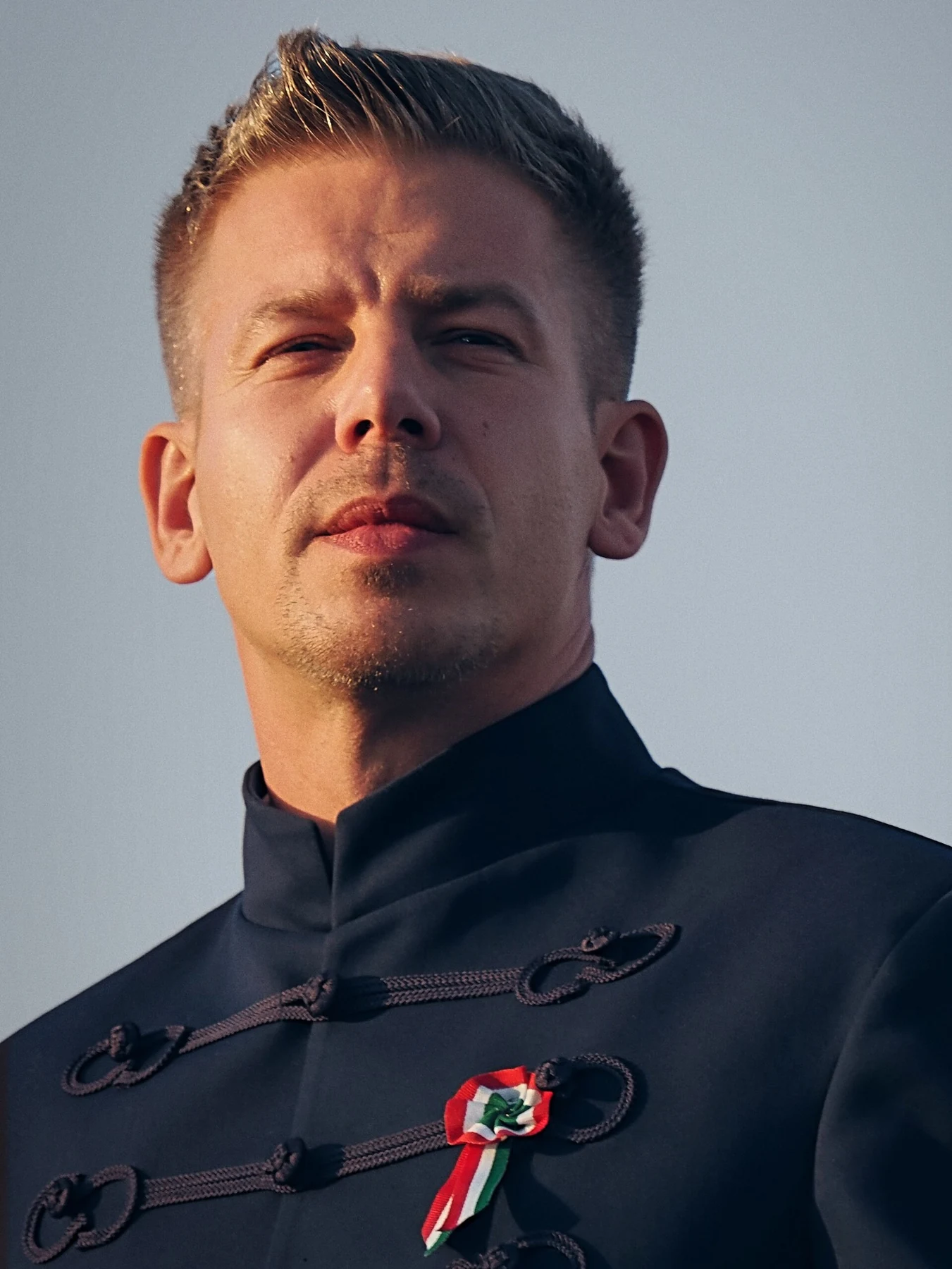
The first work of EUFÓRIA. When I uploaded it under a free licence I secretly hoped it had a life of its own in it — I had seen the signs. Then it broke out of every bubble: it became the lead image of more than fourteen Wikipedia language editions, the community chose it as the official portrait of Hungary's Prime Minister, Wikimedia placed it under protected status, and it travelled through publications of every political colour. I let one picture go free, and the world did the rest.
The afterlife of a single frame
- 15.03.2026, 16:57 — The photograph is made in golden-hour light at Heroes’ Square; the exact timestamp and geolocation stay in the metadata.
- 21.03.2026 — First critique: “The anatomy of presence — a gaze that stops time.”
- 04.04.2026 — The image detonates on X: a quarter of a million views within hours; John Cleese shares it with “Oh, please, Yes!!”
- 12.04.2026 — On election morning Péter Magyar opens the day with this image — the moment that made the photograph iconic.
- 24.04.2026 — The image is reinterpreted as a painting on canvas.
- 10.05.2026 — The Wikipedia community selects it as the official portrait of Hungary's Prime Minister.
- 25.05 – 10.06.2026 — Kiskegyed reports the image's story; Rólunk.at interviews me about the motivation behind it.
Six critiques — in brief
I. The anatomy of presence (21.03.2026)
Not a campaign poster but a confession. Trained at the Hungarian Defence Forces and carrying Capa's ethos — “if your pictures aren't good enough, you weren't close enough” — the photographer waits for the five-hundredth of a second when the mask slips and the human being remains. The low angle lends gravity; the golden hour serves truth, not flattery. Because the image was given freely to the world, it wears a moral shield no propaganda can buy.
II. A paradigm cast in light — the open-source aura (27.03.2026)
Releasing the portrait under CC BY-SA 4.0 overturned the logic of party-controlled political imagery. The image integrated into the Wikimedia network and became the primary visual identifier of articles from Norwegian to Georgian. Its precise metadata later served as an anchor of truth against disinformation about the rally itself.
III. The image that precedes its own history (02.04.2026)
Most iconic political photographs acquire meaning retrospectively. This one is anticipatory iconography — it became a global visual reference before the event it belongs to had concluded, its status renewed with every single use.
IV. Digital messiah aesthetics (04.04.2026)
The chiaroscuro depth, the silent dialogue of the gaze and the calm force it radiates worked as visual white noise amid loud negative campaigning. Its viral spread was not chaos but catharsis.
V. The anatomy of visual power (08.04.2026)
An analyst's essay on how a single photograph rewrote a country's political discourse — the hero character reclaimed through national dress, the perfectly timed amplification, a global celebrity endorsement, and sober caveats about echo chambers and polarisation.
VI. The anatomy of an icon (13.04.2026)
“The digital-age Mona Lisa”: protected status on Wikimedia as the digital equivalent of bulletproof glass in the Louvre; presence from the Japanese Wikipedia to Scandinavian political blogs; the 21st-century statesman archetype — clean, sharp, digitally native, uncompromisingly present.
Where the picture travelled
- Die Weltwoche — „Ein talentierter Schlawiner“ (09.04.2026)
- The Hungary Report — Opinion: The End of the Strongman Spell (12.04.2026)
- American Thinker — critical commentary (24.03.2026)
- SOTA — report in Russian (13.04.2026)
- The Brussels Times
- Eastern Herald
- Spectre Journal — The Hungarian Spring
- Politics UK — A new dawn for Hungary
- Kiskegyed — the story of the photograph (25.05.2026)
- Rólunk.at — interview on the motivation (10.06.2026)
These publications represent very different, sometimes directly opposing political viewpoints — including outlets that are openly critical of the person in the photograph. That is precisely the point, and precisely why I list them all. The value of an open-licensed document is not that everyone agrees with it. It is that everyone can use it.
Work Nº 2